Remy Hair vs Virgin Hair vs 100% Human Hair: A Complete Guide to Understanding Hair Quality
In the hair extension industry, few topics cause as much confusion as the terms Remy hair, Virgin hair, and 100% human hair. These phrases are often used interchangeably in product descriptions, advertisements, and even salon consultations. However, they do not mean the same thing, and misunderstanding them can lead to disappointing results, including tangling, shedding, dryness, and a much shorter lifespan than expected.
This guide explains what each term actually means, how they differ, and why understanding these distinctions is essential when choosing hair extensions for personal use or professional applications.
Why hair terminology is so confusing
The global hair market is large and fragmented, involving collectors, processors, factories, distributors, and salons across many countries. Along the way, hair is labeled, re-labeled, and marketed using simplified terms that sound appealing but often lack clarity.
“100% human hair” is one of the most common examples. While it sounds like a guarantee of quality, it only confirms that the hair came from a human source. It does not describe how the hair was collected, processed, or sorted. This is where Remy and Virgin classifications become critical.
What does “100% human hair” really mean?
At its core, 100% human hair simply means the hair was sourced from human donors rather than synthetic fibers. Beyond that, the term offers no information about quality.
Human hair extensions can vary widely in performance. Some may last months with proper care, while others tangle severely after only a few washes. The difference usually comes down to cuticle condition and processing history, not the human origin itself.
Human hair can be:
Remy or non-Remy
Chemically processed or unprocessed
Carefully sorted or mixed together
Because of this, “100% human hair” should be viewed as a starting point, not a quality guarantee.
Remy hair explained: structure and cuticle alignment
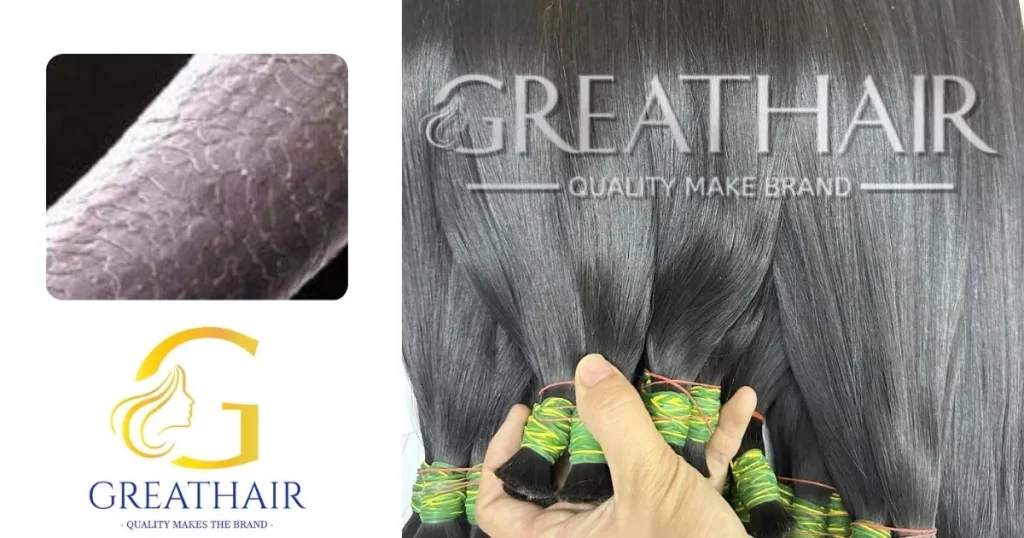
Remy hair refers specifically to cuticle alignment. In Remy hair, all cuticles remain intact and aligned in the same direction, from root to tip. This alignment is crucial because hair cuticles function like shingles on a roof. When they face the same direction, hair stays smooth and manageable.
When cuticles are aligned:
Friction between strands is reduced
Tangling and matting are minimized
Hair retains moisture more effectively
Overall lifespan is significantly longer
Remy hair is not defined by texture, color, or country of origin. Straight, wavy, and curly hair can all be Remy as long as cuticles are preserved and aligned.
Non-Remy hair and why problems occur
Non-Remy hair typically results from bulk collection methods where hair strands are gathered without regard to root direction. To compensate, manufacturers may strip the cuticles using acid treatments and apply silicone coatings to create a smooth initial appearance.
While this hair may look acceptable at first, problems usually appear after a few washes. Once the coating wears off, the hair begins to tangle, dry out, and shed. This is why some “human hair” extensions perform poorly despite looking good when first installed.
What is Virgin hair?
Virgin hair is human hair that has never been chemically processed. This means:
No dye or color treatment
No bleach
No perm or relaxer
No chemical texture alteration
Because the cuticle remains untouched, virgin hair naturally qualifies as Remy hair. However, not all Remy hair is virgin hair. Remy hair can still be lightly processed for color or texture, while virgin hair remains in its natural state.
Virgin hair is often preferred when flexibility is required, especially for coloring or bleaching. Since the hair has no chemical history, it responds more predictably to future treatments.
Is virgin hair always better than Remy hair?
Virgin hair is generally considered a higher grade, but “better” depends on the intended use.
Virgin hair is ideal for:
High-end salon services
Clients who want to bleach or color hair multiple times
Long-term installations where durability is critical

Remy hair, on the other hand, offers an excellent balance between performance and cost. For many everyday styles and standard installations, high-quality Remy hair performs extremely well and provides reliable results.
Raw hair vs virgin hair
Another term often mentioned alongside virgin hair is raw hair. Raw hair is completely unprocessed hair collected directly from donors. It has not been chemically treated, steamed, or altered in any way.
Virgin hair may be lightly cleaned and sometimes steam-shaped for consistency, but it still has no chemical alteration. Raw hair is rarer and more expensive, while virgin hair offers a more practical option for most salons and distributors.
How processing affects hair performance
Processing does not automatically mean low quality. Light processing, when done correctly, can improve consistency without damaging the cuticle. Problems arise when hair is heavily processed to mask poor sourcing or mixed cuticles.
Understanding whether hair is Remy, virgin, or simply human hair helps buyers anticipate how the hair will behave over time, especially after repeated washing and styling.
Choosing the right hair for your needs
When selecting hair extensions, consider the following factors:
How long the hair needs to last
Whether the hair will be colored or chemically treated
Maintenance expectations
Budget constraints
For short-term use or standard installations, Remy hair is often sufficient. For long-term wear or advanced coloring, virgin hair provides better durability and flexibility.
Why clear classification matters
Many quality issues in the hair industry are not caused by price, but by misunderstanding hair grades. Knowing whether hair is Remy, virgin, or simply human hair allows buyers to set realistic expectations and choose products that align with their goals.
A detailed comparison of these hair types, including real-world use cases, is explained further in this in-depth guide:
https://greathair.com.vn/remy-hair-vs-virgin-hair-vs-100-human-hair/
Final thoughts
Remy hair, virgin hair, and 100% human hair are not interchangeable terms. Each describes a different aspect of hair quality:
Remy hair defines structure and cuticle alignment
Virgin hair defines chemical history
Human hair defines origin
Understanding these distinctions leads to better decisions, fewer quality issues, and more consistent results. Whether you are a consumer, salon professional, or distributor, clarity at the classification stage is the foundation of long-lasting, high-performing hair extensions.


Comments
Post a Comment